Lua Beautifier: Format Lua Code Free in Your Browser
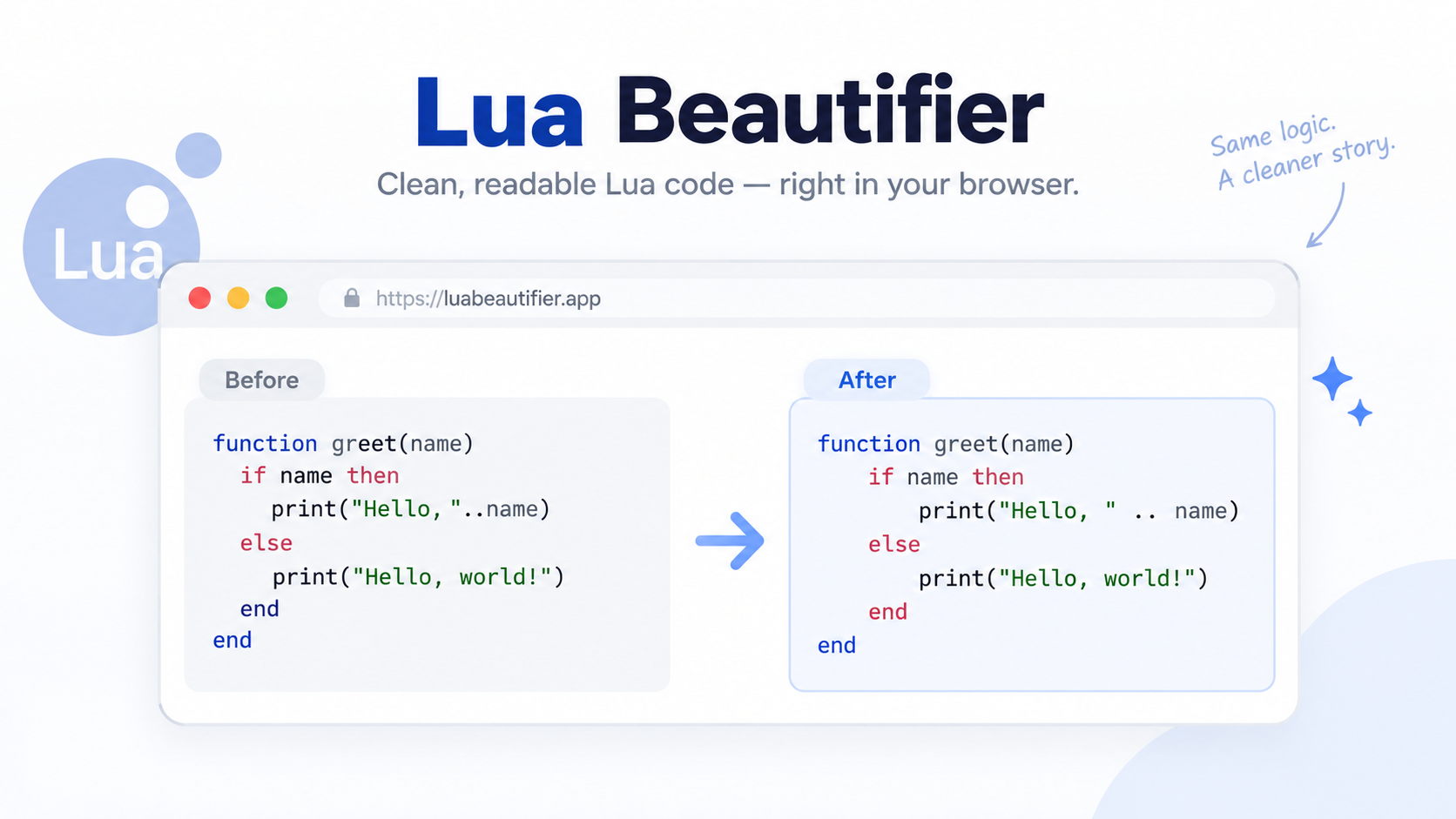
A Lua beautifier — also called a Lua formatter or pretty-printer — rewrites Lua source into clean, consistent indentation and spacing without changing how the code runs. In 2026, most are free browser tools that format pasted Lua 5.5, LuaJIT, or Luau code locally, while editors can auto-format Lua on save.
How to Beautify Lua Code in 3 Steps
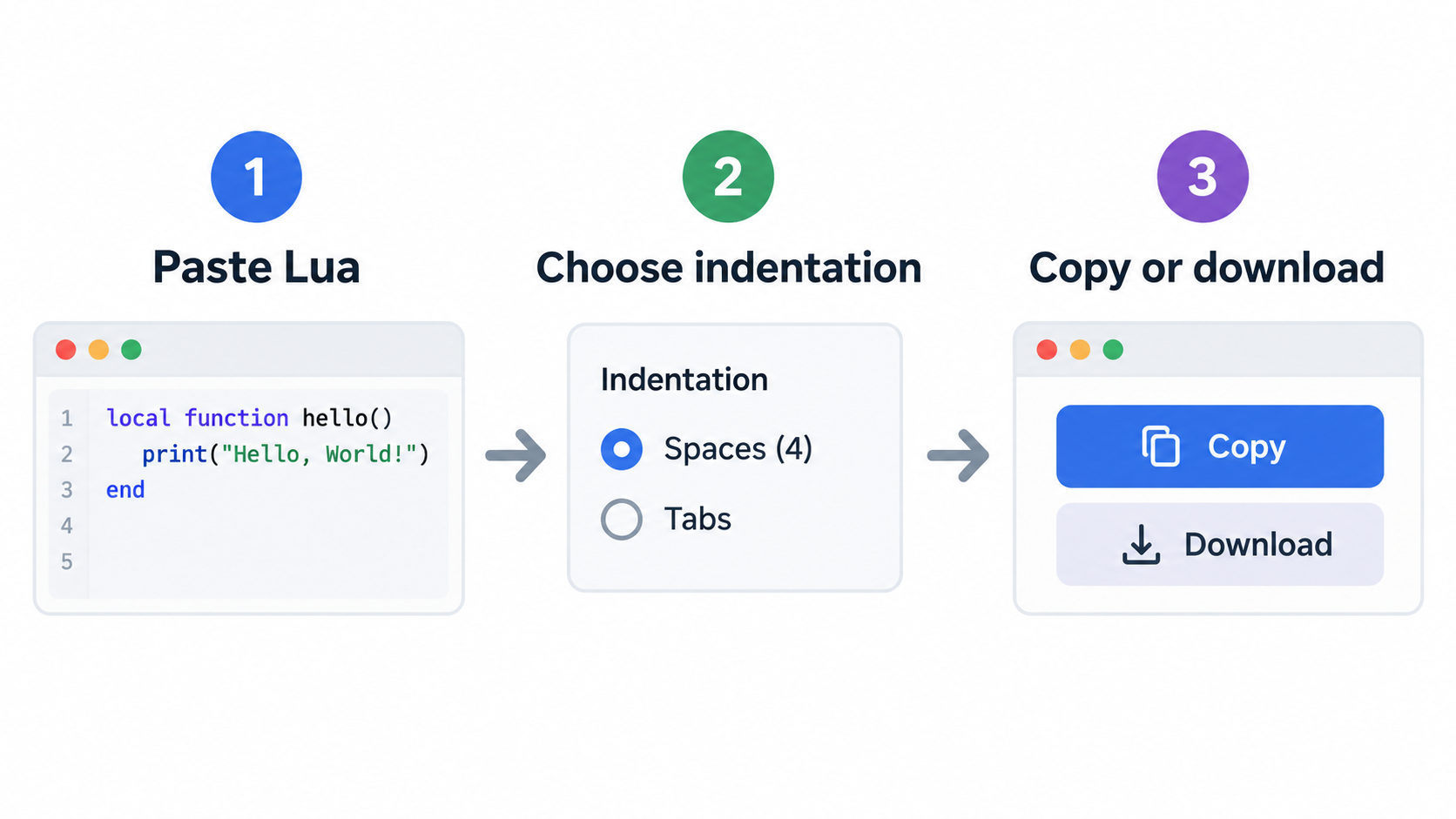
The browser workflow is short: paste, configure, take the result back.
Step 1 — paste. Drop raw Lua into the online Lua beautifier. No account, no install, no download. The code stays in the tab you pasted it into.
Step 2 — configure. Choose your indentation before you format: 2 spaces, 4 spaces, or tabs. Two spaces is the common default in Lua and Luau codebases, so stick with it unless a project’s existing style says otherwise.
Step 3 — copy or download. Run the format, then copy the output straight back into your editor or download a .lua file. That’s it.
Does the Lua beautifier upload my code?
It depends on the tool, and the privacy-first pattern is worth looking for explicitly. Browser formatters that process locally state no upload and no account required, and they cap in-browser preview length rather than server-side file size — Phoenix Code’s HTML formatter (updated September 28, 2026) puts that ceiling at 2,000,000 characters and runs the formatting client-side, which is the same pattern a Lua tool can follow. Before you paste proprietary code, look for a local-processing statement instead of trusting a generic “secure” badge.
What you get back: copy, download, or paste straight into your editor
The output is plain text, so it goes into whatever you already have open. Copy it into the file you were editing, or download a .lua file and drop it beside the project. When the input is production code, diff the result against the source first and confirm that only whitespace moved.
A full Lua parser fits in a web page because Lua itself is small. According to Lua.org, the Lua 5.5.1 tarball — source code plus documentation — is 390K compressed and 1.5M uncompressed, around 32,000 lines of C. That’s a reasonable payload for a client-side tool.
What a Lua Beautifier Changes — and What It Leaves Alone
A beautifier normalizes indentation, spacing around operators, blank lines, and line breaks. It does not rename, reorder, evaluate, or delete code.
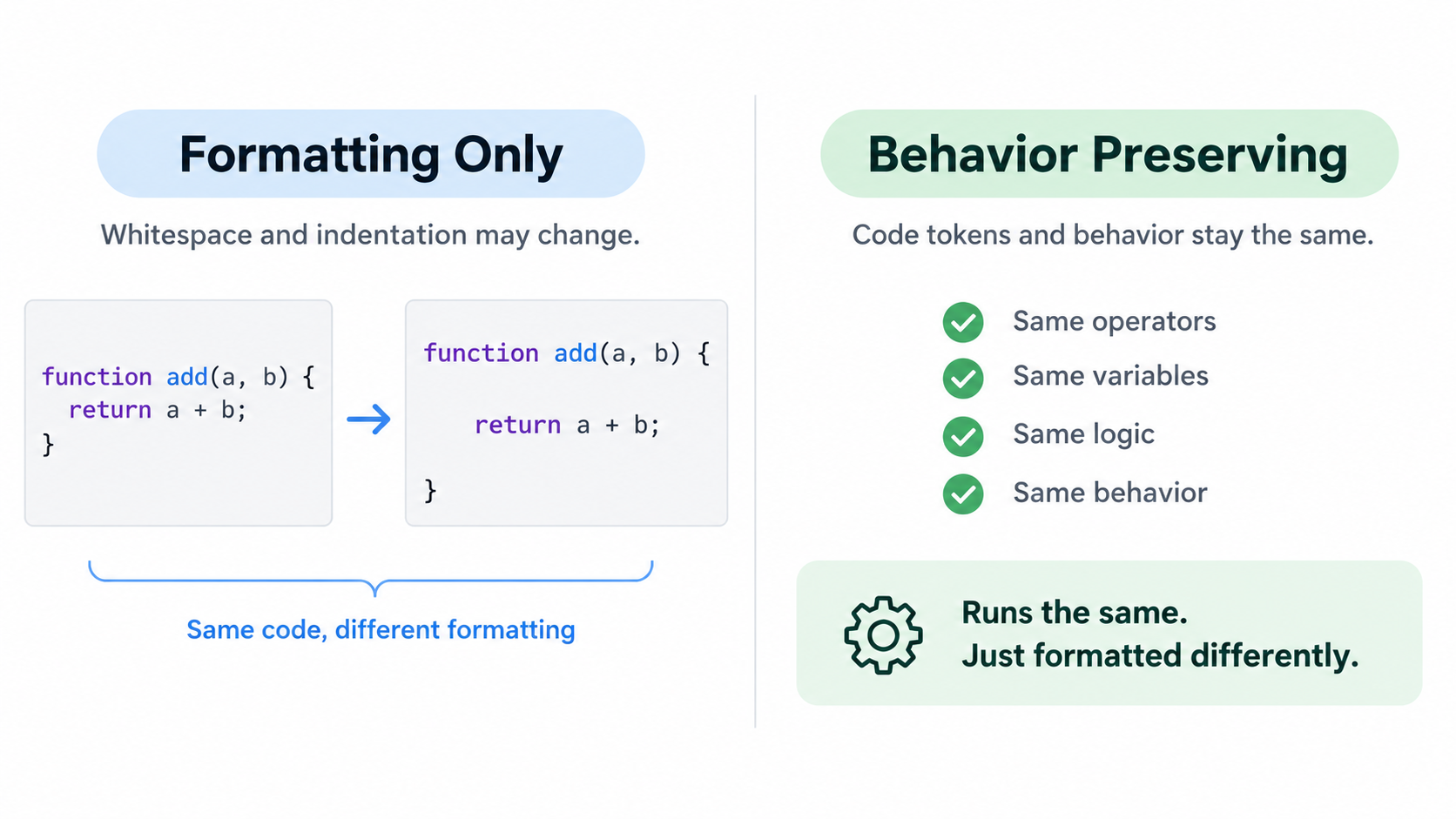
That behavior-preserving property is structural, not a promise: the token stream is untouched and only the whitespace between tokens moves. A file that formats cleanly should produce byte-identical output when it runs.
It also won’t find syntax errors or logic bugs. That’s a validator’s or a linter’s job, and the strongest formatter-shaped tools draw that line explicitly. Phoenix Code states the distinction in one sentence — a formatter changes whitespace, a validator checks conformance, and a browser parser may infer missing elements and repair a document tree. The same split applies to Lua.
Long bracket strings ([[ ... ]]) and long comments (--[[ ... ]]) have to be preserved byte-for-byte, for the same reason formatters protect raw-content regions in HTML: the text inside is literal, and re-indenting it changes rendered output.
Is a Lua beautifier the same as a Lua formatter, minifier, or validator?
A beautifier and a formatter are the same job under two names — rewriting whitespace for readability. “Beautifier” usually implies re-expanding something minified or unreadable, but the implementation is identical.
A minifier does the opposite: it strips whitespace to shrink the file. A validator neither reflows nor shrinks; it reports whether code conforms to a syntax or rule set, and it leaves your layout alone.
Beautifier vs. linter vs. AI code generator
A linter reports suspicious or incorrect code without changing layout. An AI code generator is a different category again: it writes new Lua from a description rather than rearranging Lua you already have. Zenifiq’s Lua generator page makes the limitation plain — generated code still has to be verified, because the tool cannot test against your host and won’t keep pace with API changes.
So the division of labor is: the beautifier reflows, the linter inspects, the generator authors.
Which Lua Do You Have: Lua 5.5, LuaJIT, or Roblox Luau?
Lua.org describes Lua as “a powerful, efficient, lightweight, embeddable scripting language” that supports procedural, object-oriented, functional, data-driven, and data-description styles. That breadth is exactly why one canonical layout can’t fit every Lua file — and why the answer to “which beautifier” depends on which grammar you pasted.
Plain Lua 5.x — the current line is 5.5.x — is the baseline grammar most beautifiers target first. LuaJIT is the runtime behind Neovim’s init.lua and LÖVE2D, and its accepted syntax is a superset-with-caveats of standard Lua. Roblox Luau adds type annotations, continue, and changed standard-library behavior, so a formatter tuned only for plain Lua can mangle or reject Luau type syntax outright.
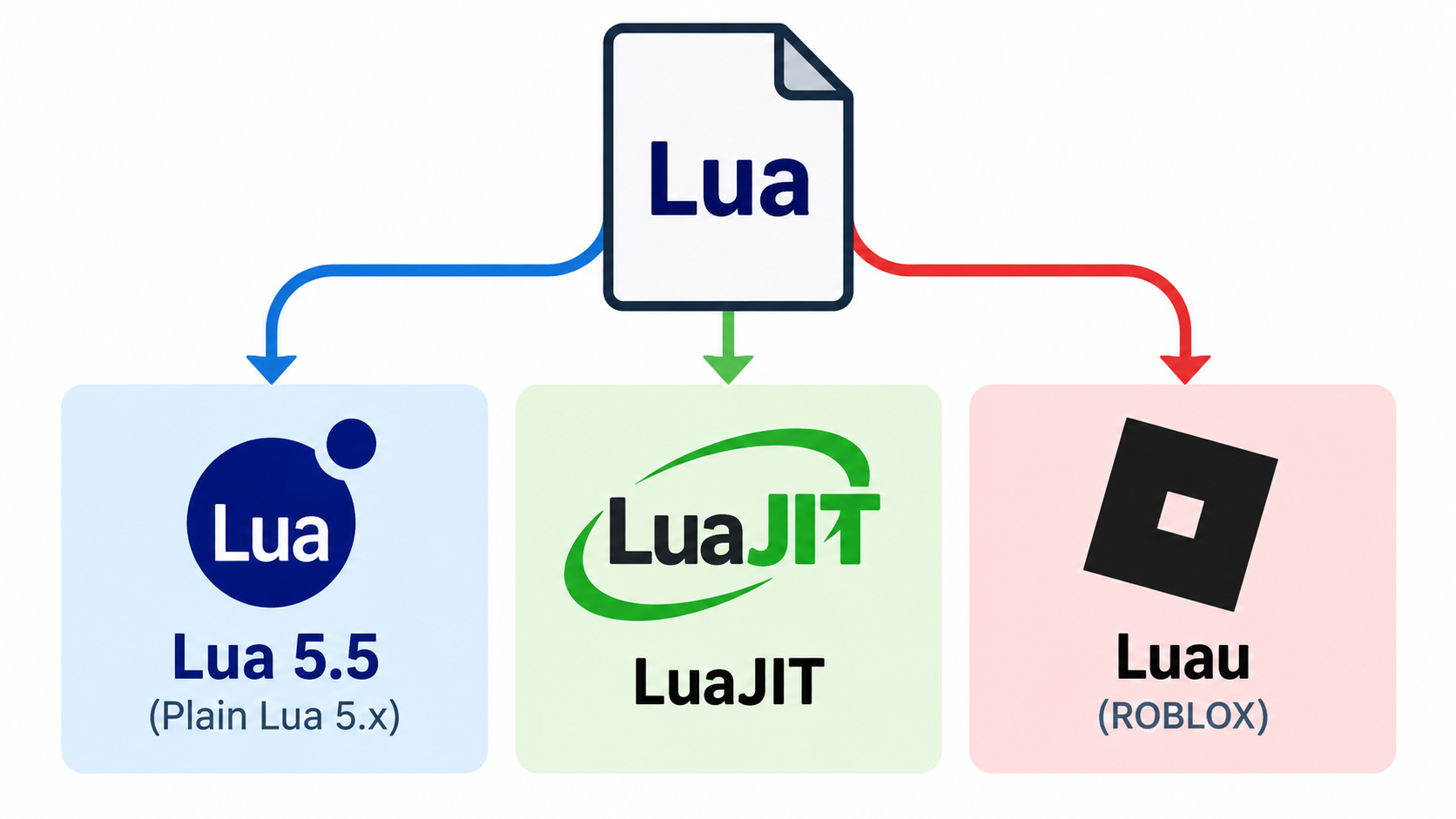
Lua has existed since 1993 and was profiled at HOPL III in 2007, so no single frozen grammar covers every file a reader will paste into a box.
What host is your Lua embedded in? Roblox, Neovim, LÖVE2D, Redis, or standalone
Lua is almost always embedded, and the host API — not the syntax — decides what a script can do. Roblox runs Luau. Neovim uses Lua for configuration. LÖVE2D drives games with it. Redis exposes redis.call with KEYS and ARGV as the only way in. Formatting expectations differ per host: the type annotations a Roblox team expects carry no meaning inside a Redis script.
Real embedded Lua can be long and unusual. On the darktable forum, a user wrapped image tagging in a Lua script that scores every photo against a fixed vocabulary of roughly 1,000 labels — the 365 scene categories of Places365 plus the 601 object classes of OpenImages V7 — then rewrote it to run purely in Lua against imported .dtmodels files with no Python involved. Scripts at that scale are exactly where formatting stops being cosmetic.
Roblox Luau: type annotations a plain Lua beautifier may not expect
Luau is not Lua with a different name. It adds a type system and its own features, and some standard Lua behavior is absent. A formatter built for plain Lua may treat local x: number = 1 as a syntax error, or strip the annotation because it doesn’t recognize the construct.
Check the tool’s stated dialect coverage before pasting Luau, and treat “supports Lua” as an unverified claim until you’ve tested a typed snippet. A dedicated Luau formatter handles the typed grammar natively, and a one-line annotation test tells you more than a feature list does.
Who maintains Lua — and why the MIT license matters for browser tools
Lua is designed, implemented, and maintained by a team at PUC-Rio, the Pontifical Catholic University of Rio de Janeiro in Brazil, and is now housed at LabLua within the university’s Department of Computer Science. It’s free open-source software under the MIT license and may be used for any purpose, including commercial purposes, at no cost.
That licensing is what makes a client-side beautifier straightforward: a browser tool can ship a Lua parser without navigating a restrictive redistribution term.
Lua Beautifier Settings That Actually Matter
Most options are cosmetic. A few change how readable your code stays in version control.
The clearest model for a Lua beautifier’s option set is a formatter UI that exposes indentation, wrapping, and preserve-newline controls directly rather than burying them in a config file.
2 spaces, 4 spaces, or tabs: picking a Lua convention
Two spaces is the common default in Lua and Luau codebases. Four spaces shows up in many C-adjacent and game-engine shops. Tabs render at whatever width a reader’s editor is set to, which makes diffs inconsistent across machines.
Match the file you’re editing before you format a project file. Converting a whole file from 4 spaces to 2 is safe but produces a diff with no review value.
Wrapping, alignment, and the preserve-newlines setting
Set a max line width, or leave lines untouched. If you hand-grouped a table across multiple lines for a reason, enable the preserve-existing-newlines option — otherwise a formatter may collapse the grouping into one long line.
Keep long bracket strings and long comments verbatim; reflowing inside [[ ]] can change rendered output. Trailing whitespace removal and a single final newline are cosmetic, safe, and worth turning on. When the input is production code, look at the preview or diff before you copy.
Format Lua on Save: VS Code, Neovim, and CLI Without a Web Tool
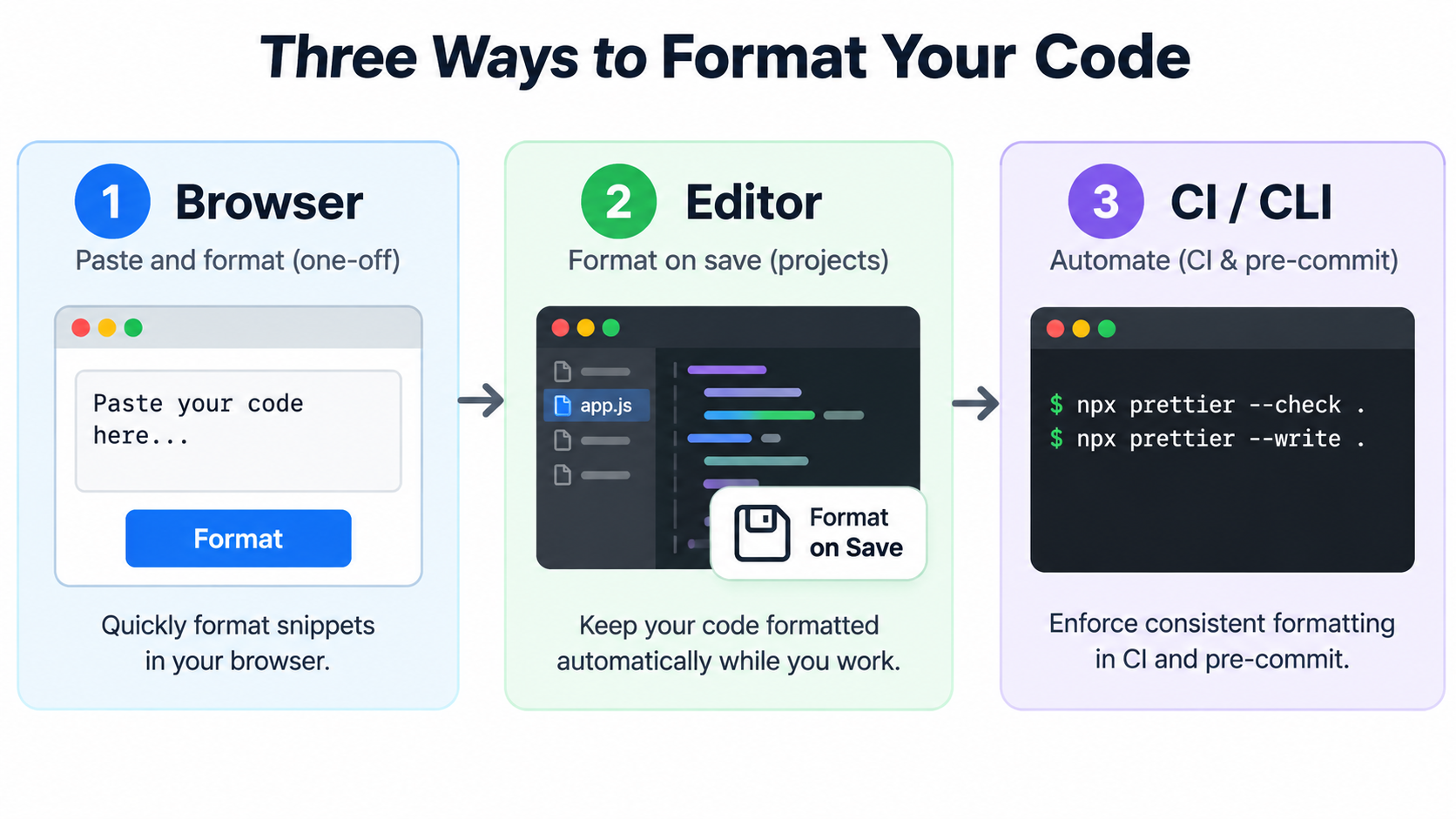
A browser tool handles a one-off paste. Once a project has a style worth keeping, wire formatting into the editor so it happens without a decision.
VS Code: Lua language server plus format on save
Install a Lua language server, enable format-on-save, and let the server handle indentation on every write. The formatter that runs is the same kind of formatter a browser tool ships — the difference is that it fires automatically instead of on paste.
Neovim: vim.lsp.buf.format on BufWritePre (and the version trap)
In Neovim, formatting is wired to BufWritePre, so every :w reformats the buffer:
vim.api.nvim_create_autocmd('BufWritePre', {
  group = vim.api.nvim_create_augroup('my.format', {}),
  callback = function(ev)
    if #vim.lsp.get_clients({ bufnr = ev.buf, method = 'textDocument/formatting' }) > 0 then
      vim.lsp.buf.format({ bufnr = ev.buf, timeout_ms = 2000 })
    end
  end,
})
Check versions before writing that config. As of October 2026, per Terminal Skills’ Neovim skill (updated October 1, 2026), vim.pack requires Neovim 0.12, vim.lsp.config and vim.lsp.enable require 0.11, and nvim-lspconfig requires 0.11.3 or newer. The stable line referenced is 0.12.5.
Migrating off the deprecated require('lspconfig').<server>.setup{} framework means replacing each call with vim.lsp.config (settings) plus vim.lsp.enable (activation), and moving on_attach logic into an LspAttach autocommand. Verify it headlessly:
nvim --headless -c 'if v:errmsg != "" | cquit 1 | endif' -c qa
Then confirm :checkhealth vim.lsp lists your servers under Enabled Configurations. Follow that documented migration path and the deprecation warning goes away, with the servers appearing there.
CLI formatters for CI and pre-commit hooks
For CI and pre-commit hooks, run a standalone Lua formatter — StyLua or LuaFormatter — against a file or a directory, so formatting is enforced before review. The same guidance applies: for editor-agnostic tasks like formatting in CI, call the formatter or linter directly instead of routing through an editor.
Which route to pick: paste into a browser tool for a snippet you can’t install anything for, and move to format-on-save once a project has a style to keep.
Is Beautifying Lua Safe? nil Gaps, 1-Based Indexing, and Behavior
Beautifying is safe when it’s purely whitespace-level, and the failure modes worth knowing about are the ones formatting never touches.
Does beautifying Lua code change how it runs?
No. Whitespace between tokens is not significant in Lua, so indentation and spacing changes are behavior-preserving by construction. Long strings and long comments must survive verbatim, or embedded text inside them would change — the same guarantee a formatter gives when it protects raw-content regions during transformation.
Safe doesn’t mean correct, though. A beautifier never fixes nil gaps, indexing errors, or host API misuse.
What no formatter can fix: nil gaps, 1-based indexing, host API misuse
Three traps catch newcomers and generated code alike. A table’s length is undefined once the table contains nil gaps. Array indexing starts at 1, not 0. And the host API dictates what any script is allowed to do. Zenifiq’s Lua generator documentation names all three and points at the pattern where they meet: generated Lua that removes items from an array mid-loop.
A formatter will happily preserve a nil gap inside a table, and #t will still return an unexpected length afterward. Indentation is not a correctness check.
Formatting also can’t fix architectural problems inside embedded scripts. On the darktable forum, the script’s author warns that tagging hundreds of images at once can freeze the application’s UI — “it is in the end a Lua script” — and another user reports Argus taking about two minutes to prepare its model and Artemis about eight on Windows 11. No beautifier changes that.
The practical verification is to re-run your tests after formatting, or diff the token stream rather than the text.
Conclusion
A Lua beautifier only rewrites whitespace — which is exactly why it’s safe, and exactly why it can’t fix the dialect, version, or semantic problems hiding in your Lua. It solves readability; it does not solve correctness.
Paste one snippet into a browser Lua beautifier now and confirm which dialect you’re looking at — plain Lua 5.x, LuaJIT, or Roblox Luau. Then, once the style is settled, wire format-on-save into your editor so formatting stops being a manual step and becomes something that happens when the file is saved.
FAQ
Is a Lua beautifier the same thing as a Lua formatter or a Lua linter?
A beautifier and a formatter are the same job under two names: rewriting whitespace for readability. A linter is different — it reports suspicious or incorrect code without changing layout. Most tools keep the two separate, and some offer beautify, minify, and validate as distinct actions.
Does beautifying Lua code change how it runs?
No. Whitespace between tokens is not significant in Lua, so indentation and spacing changes are behavior-preserving. Long strings and long comments must be preserved verbatim, or embedded text inside them would change. Safe doesn’t mean correct: a beautifier never fixes nil gaps, indexing errors, or host API misuse.
Does an online Lua beautifier support Lua 5.4, Lua 5.5, LuaJIT, and Roblox Luau?
Support varies by tool. Plain Lua 5.x is the usual baseline, and the current line is Lua 5.5.x. LuaJIT (Neovim, LÖVE2D) and Roblox Luau are separate grammars; Luau adds type annotations and changed standard-library behavior. Check the tool’s stated dialect coverage before pasting Luau, and treat “supports Lua” as an unverified claim until you test a typed snippet.
Is my Lua code uploaded to a server when I use an online beautifier?
It depends on the tool. The privacy-first pattern is client-side processing entirely inside the browser tab. Browser formatters that advertise local processing state no upload and no account required, and cap in-browser preview length instead of server-side size. For proprietary or NDA-covered scripts, use a local editor or CLI formatter rather than trusting a claim you can’t verify.
Can I auto-format Lua on save in Neovim or VS Code without a web tool?
Yes — wire the LSP formatter to a write event: BufWritePre plus vim.lsp.buf.format in Neovim, format-on-save in VS Code. Check versions first: Neovim 0.12 for vim.pack, 0.11 for vim.lsp.config/enable, and 0.11.3+ for nvim-lspconfig as of October 2026. Verify the config headlessly and with :checkhealth vim.lsp so a broken formatter never silently skips a file.